Streamlining Design for Patient Care
Creating Healing Spaces for Cancer Center in Ogden, Utah
by Tysen Gannon, LEED AP, AD Systems
In March 2024, the Intermountain Cancer Center McKay-Dee Hospital opened its doors to bring cancer care closer to home for residents of Northern Utah. The largest renovation project Intermountain McKay-Dee Hospital has undergone since it’s opening in 2002, the new state-of-the-art cancer center consolidates multiple treatment services into a single location for more comprehensive patient care.
“I’ve worked on many cancer centers throughout the West, including what I’ll say are the best in Utah, and the Intermountain Cancer Center McKay-Dee Hospital, represents the latest evolution in cancer treatment,” said Nathan Murray, design partner and Vice President at TSA Architects, the architectural firm that worked on this life-giving project.
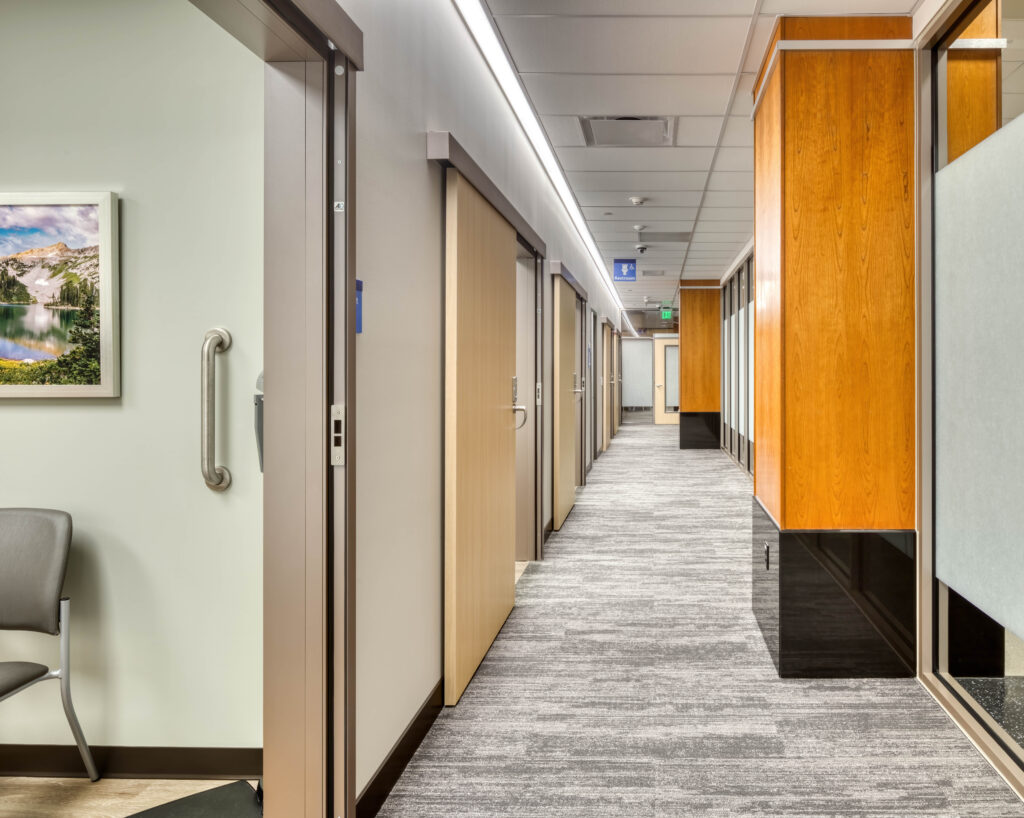
To optimize the first-floor cancer center for space use and the patient healing process, TSA prioritized adaptable, flexible, and space-saving solutions during the design phase. These priorities extended to the Medical Oncology Suite, an area where the hospital needed to maximize the functionality of the floor plan to accommodate more patients.
To help facilitate this project goal, TSA turned to high-performance sliding doors from AD Systems™. “Our firm does the best cancer center work in the state. So, we wanted to bring in the right products and most experienced partners,” said Murray.
To best utilize the layout of the exam rooms in the Medical Oncology Suite, TSA used the on-stage/off-stage model, which makes it possible to shift patient and provider environments from shared to separate spaces. With this model, patients enter exam rooms from the public-facing “on-stage” corridor while hospital personnel enter from the “off-stage” area, which is a private space for staff and their workstations. This dual-entry approach also supports traffic flow and adheres to acoustic-isolation demands. Further, it can contribute to shorter wait times for patients.
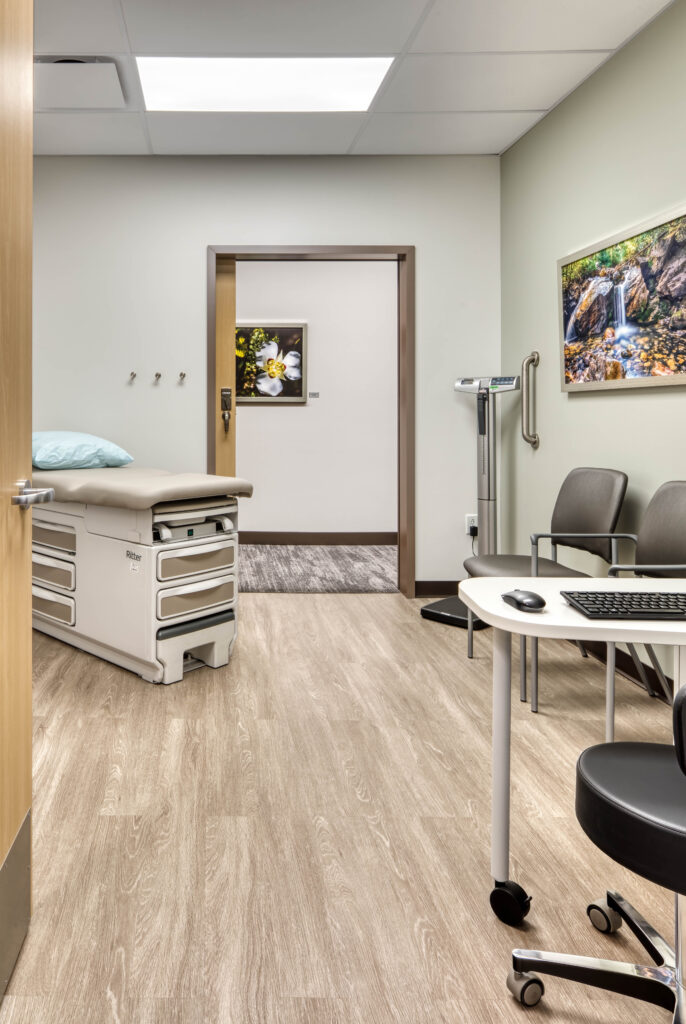
To achieve this configuration, TSA incorporated multiple sliding door systems throughout the Medical Oncology Suite. With these flexible openings, the swing path of a traditional swing door is eliminated. This helps designers prioritize space savings and ensure ease of maneuvering throughout the exam room. “I’ve been in health care design for 25 years now and we’ve seen desired door clearances get wider to support the movement of people in wheelchairs or with other mobility aids,” added Murray. “Here, we did not have the real estate to devote to a hinged door.”
By removing the space needed for swing doors to operate, openings can be widened beyond minimum accessibility requirements outlined in the Americans with Disabilities Act standards (ADA). Further, without a swing arc, design teams do not have to plan for extra space for approach and maneuvering clearances, which supports accessibility while contributing to optimized space-use.
The smooth, space-saving operation of commercial sliding doors does more than contribute to more accessible and efficient exam rooms. It can also improve wayfinding by easing congestion and corridor blockage by more readily allowing dual-entry design. For the Medical Oncology Suite at Intermountain Cancer Center McKay-Dee Hospital, this supports the hospital’s goal of providing the best possible care to patients in a calming and supportive atmosphere.
The dual-entry design contributes to intuitive navigation for patients and efficient movement for providers. As such, it can help medical professionals provide the best level of care by creating an environment that is comfortable, efficient, and designed for healing. It can also contribute to a more positive patient experience overall.
To this point, Murray added, “We celebrate transparency in health care environments. We want patients to see where they’re headed and where they’ve been. This creates a natural sense of wayfinding, which reduces stress levels.”
While generally, sliding door systems can support space-efficient and flexible design, it is important to note not all sliding doors are the same. To meet best practices for today’s health care facilities, specifying ADA-compliant doors with high-quality, commercial-grade hardware, and a precision-engineered framing system can help ensure long-lasting door systems that require minimal maintenance.
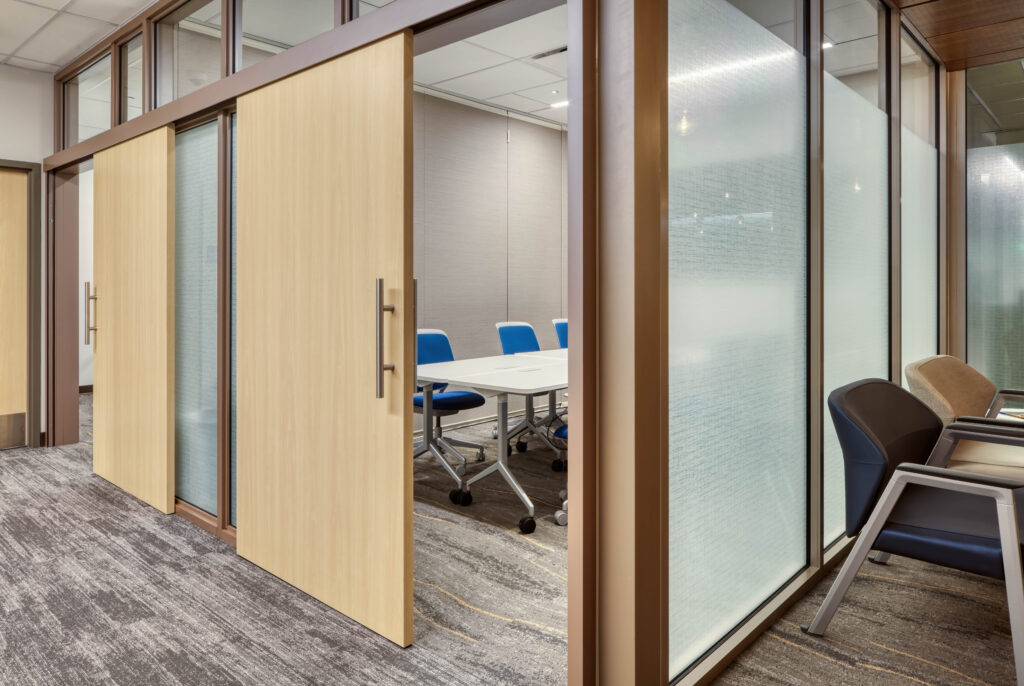
Used throughout the Medical Oncology Suite, the hardware in the sliding door systems is ADA-compliant since it can be operated with one hand and without tight grasping, pinching, or twisting of the wrist. Further, ExamSlide™ from AD Systems, the sliding door system used in this project, was top-hung to eliminate exposed floor tracks and door guides, supporting to accessibility for wheelchairs, rolling IVs, and other medical equipment. Also, the TSA team incorporated glazing with integral cord-free louvers. These hermetically-sealed glass units maintain building hygiene while allowing occupants to choose the level of visual connection or privacy needed.
Going with AD Systems’ ExamSlide for the Intermountain Cancer Center McKay-Dee Hospital was the clear choice for Murray, whose firm is entirely dedicated to health care architecture. His confidence in AD Systems and the manufacturer’s high-performance sliding doors can be traced back to a health care project completed more than a decade ago.
In 2014, TSA specified AD Systems’ ExamSlide during the redesign of Mountain View Hospital’s Emergency Department (ED) in Payson, Utah. Speaking to his initial introduction to AD Systems, “Their team was helpful when it came to working through the different applications and details that we needed to solve and design for,” Murray said. “Because of our good experience with the ED in Payson, we knew we could stand by the product for the cancer center. AD Systems’ sliding doors are very high-quality in that they’re durable, well-engineered and look sharp.”
Underlining the peace of mind that comes with working with an experienced manufacturer on health care projects like the ED in Payson and the Intermountain Cancer Center McKay-Dee Hospital, Murray adds, “AD Systems will go the distance with us. They are not afraid to tackle difficult applications and entertain our ideas. I love that. So, why not stick with AD Systems? That’s my motto. If I find a good partner and team to work with, I’m going to keep working with them.”